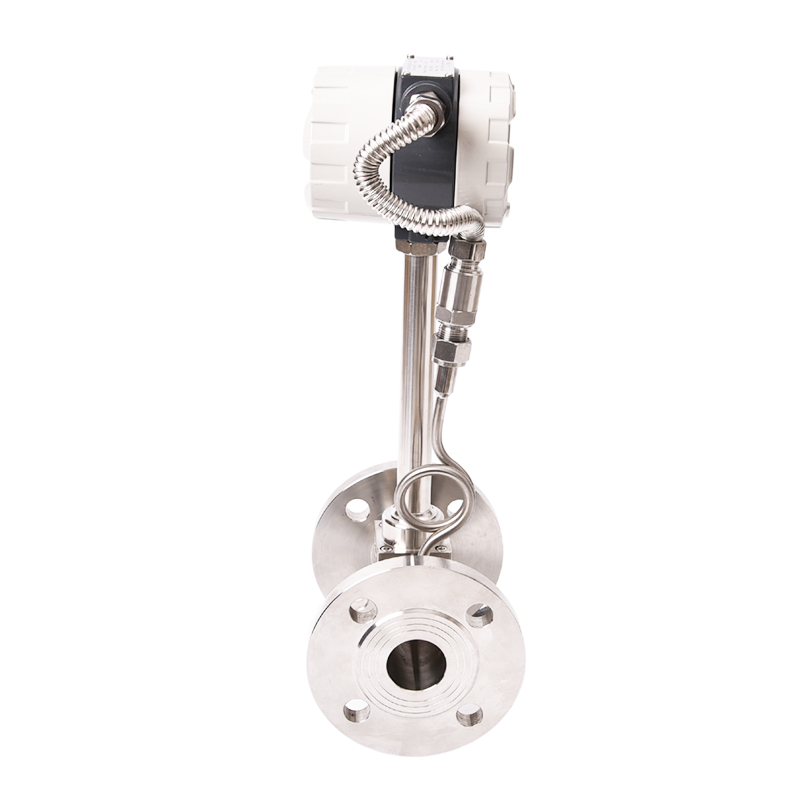

Inline turbine flowmeter is a widely used velocity-type flowmeter used to measure the volumetric flow rate of fluids in pipes. It is typically installed directly in closed pipes.
Basic Components
A pipe-type turbine flowmeter primarily consists of the following core components:
- Housing (body): Forms the channel through which the fluid flows, typically cylindrical in shape, with flanges or threaded connections for connecting to the pipeline.
- Rotor (turbine): This is the core sensing element of the flowmeter, a wheel with blades mounted on the shaft at the center of the housing, capable of free rotation.
- Shaft and bearings: Support the rotor, enabling smooth, low-friction rotation within the fluid. The type of bearing (e.g., ball bearings, sleeve bearings) affects the flowmeter’s performance and application range.
- Signal detector (sensor): Used to detect the rotation of the rotor blades. Common types include electromagnetic induction (generating pulse signals when the blades pass by) or photoelectric (generating pulses by blocking a light beam).
- Flow straightener (rectifier): Typically located upstream of the rotor, it eliminates vortex flow in the fluid, ensuring the fluid passes through the rotor in a more stable axial flow, thereby improving measurement accuracy.
Advantages
- High measurement accuracy and repeatability: Within its applicable flow range, the turbine flowmeter typically provides good measurement accuracy (generally between ±0.5% and ±1%) and excellent repeatability.
- Wide turndown ratio: Typically has a wide turndown ratio (e.g., 10:1 to 20:1), capable of covering a large range of flow changes.
- Output signal is a pulse signal, easy to digitize: The signal generated by the turbine rotation is in pulse form, with the pulse frequency proportional to the flow rate. This digital signal is easy to interface with computer systems or digital instruments for cumulative and instantaneous flow rate display.
- Relatively compact structure: For a given pipe size, the turbine flowmeter has a relatively compact volume.
- Fast response speed: It responds sensitively and quickly to changes in flow rate.
- Cost is relatively moderate: For clean fluid applications, its cost is typically lower than some high-end flow meters (such as Coriolis flow meters).
- Installation is convenient (relative to certain types): As a pipeline-mounted instrument, installation requires cutting into the pipeline, but once installed, it is relatively stable and reliable.
Limitations
- Contains moving parts prone to wear: The turbine rotor is a moving part, and the shaft and bearings wear out over time due to fluid flow, especially in fluids containing solid particles, fibers, or impurities, which can accelerate wear and affect accuracy and lifespan. This is its primary limitation.
- High requirements for fluid cleanliness: Not suitable for fluids containing large amounts of suspended solids, particles, or viscous substances, as these materials can cause blockages or wear on the rotor and bearings.
- Some pressure loss: The turbine rotor creates resistance in the pipeline, resulting in some pressure loss, which must be considered in systems sensitive to pressure drop.
- Accuracy affected by fluid viscosity: Especially at low flow rates, changes in fluid viscosity can affect measurement accuracy. High-viscosity fluids are not suitable for standard turbine flow meters.
- High requirements for straight pipe sections: To ensure accurate measurement, sufficient straight pipe sections are required upstream and downstream of the flow meter (typically 10–20D upstream and 5D downstream, where D is the pipe diameter) to ensure stable fluid flow.
- Bearings may require regular maintenance or replacement: Depending on fluid properties and operating conditions, bearings may require regular inspection, lubrication, or replacement.
- Not suitable for low flow rate measurement: At extremely low flow rates, the fluid may not generate sufficient force to overcome bearing friction and stabilize turbine rotation, leading to inaccurate or impossible measurements.
Applications
Pipe-mounted turbine flow meters are primarily used for measuring clean, low-viscosity fluids and are commonly found in the following applications:
- Petroleum and natural gas: Measurement of refined petroleum products (gasoline, diesel, etc.) and clean natural gas.
- Chemical industry: Measurement of clean, non-corrosive low-viscosity chemicals and solvents.
- Water treatment: Distribution and measurement of tap water and treated clean water.
- Food and Beverage: Measurement of clean liquid raw materials (such as pure water, alcohol) and finished liquid products.
- Pharmaceutical: Measurement of high-purity liquids such as pure water and injectable water.
- General Industry: Measurement of clean process water, cooling water, and clean compressed air, etc.
| Brand | Apure |
|---|---|
| Model | APT |
| Nominal diameter | DN25 – DN500 |
| Flow range | 0.4 – 10000 m3/h |
| Work pressure | 1.0 – 42.0 MPa |
| Accuracy grade | 1.0, 1.5 |
| Repeatability | 0.33, 0.5 |
| Usage conditions | Environmental humidity: -30℃ to +65℃ Relative humidity: 5% to 95% Atmospheric pressure: 86kpa to 106kpa |
| External power supply | 24VDC±15%, microwave < 5% |
| Output | A: Pulse or equivalent (adjustable) B: Two-wire 4-20mA, three-wire 4-20mA, four-wire 4-20mA C: RS485 D: Hart protocol output |
| Protection grade | IP65 |