
A vortex flowmeter is an instrument that measures the flow rate of fluids (liquids, gases, steam) using the Karman vortex street principle. When a fluid flows past a non-streamlined obstacle (known as a vortex generator) installed in a pipeline, two rows of regular, counter-rotating vortices are alternately generated on both sides downstream of the generator, resembling a “vortex street.” This is the famous Karman vortex street.
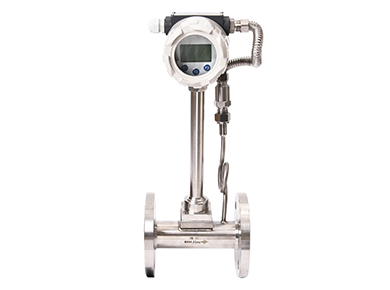

How does an Vortex flowmeter work?
The core principle of vortex flow meters lies in the fact that the frequency of vortex shedding is directly proportional to the fluid velocity.
When fluid flows past the vortex generator, alternating pressure differences are created on both sides of the generator, causing it to vibrate slightly. Sensors inside the flow meter (such as piezoelectric crystals) detect and capture these periodic vibration signals caused by vortex shedding. By measuring the frequency of these signals, the flow meter can calculate the average fluid velocity. Combined with the known cross-sectional area of the pipe, this allows for precise determination of the fluid’s volumetric flow rate. Many advanced vortex flow meters also integrate temperature and pressure sensors to enable measurement of mass flow rates for gases and steam, as their density is significantly affected by temperature and pressure.
Advantages
First, it has no moving parts, which means it has a simple structure, high reliability, and minimal wear, thereby significantly reducing maintenance requirements and extending service life. Second, it is suitable for a wide range of media, accurately measuring liquids, gases, and steam. Additionally, the vortex flowmeter offers high measurement accuracy and low pressure loss, causing minimal energy loss in fluid systems. It has a wide turndown ratio, accommodating significant flow variations, and its stable pulse output signal facilitates data processing and automated control.
Applications
Vortex flow meters are widely used across various industries, particularly excelling in steam and gas measurement applications. They are an ideal choice for measuring saturated steam and superheated steam, commonly employed in boiler rooms, heating networks, and monitoring industrial steam consumption. In gas measurement applications, they accurately measure compressed air, natural gas, fuel gas, and various industrial gases. Additionally, vortex flow meters are frequently used to measure water, oils, and chemical liquids, among other liquid media. With its reliability and accuracy, it plays a crucial role in energy management and industrial process control, helping businesses achieve energy savings and optimize production processes.