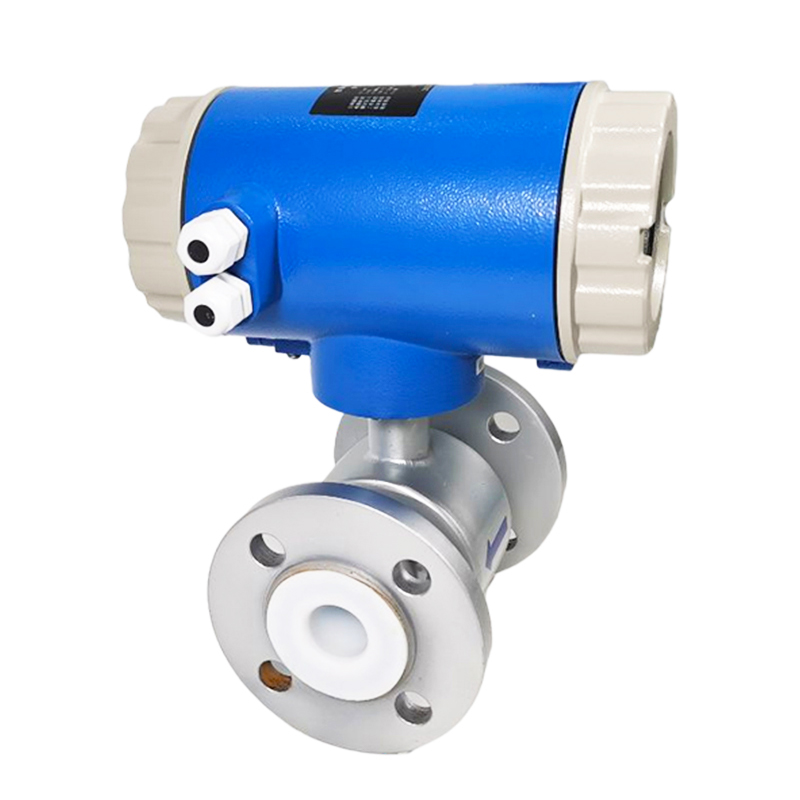


The integrated electromagnetic flowmeter combines the flow sensor, transmitter, and display unit into one unit. Its convenience, compactness, and cost-effectiveness make it particularly suitable for applications with high requirements for installation space, installation time, and ease of operation.
Structure
Sensor section: Installed in the pipeline, it typically includes an electromagnetic coil, sensing electrodes, and an insulated pipe. This section is responsible for sensing voltage signals in the fluid.
Integrated signal processing section: Designed as an integral part of the sensor, it includes signal amplification, conversion, processing, and display functions. It directly provides usable flow data output, typically in the form of digital signals (such as 4-20 mA, pulse signals, etc.).
Advantages
- Compact design: The sensor and converter are integrated into a single unit, resulting in a compact size, attractive appearance, and minimal installation space requirements.
- Easy installation: No separate installation or connection of signal cables between the sensor and converter is required, reducing on-site wiring and commissioning work, and making installation faster and more convenient.
- Relatively low cost: Compared to split-type electromagnetic flowmeters, the integrated design reduces the number of components and installation steps, typically resulting in more economical costs.
- Strong Interference Resistance (Possible): Since the sensor and converter are located close together, the signal transmission path is short, reducing the impact of external electromagnetic interference on the measurement signal and improving measurement stability.
- Easy to Operate and Maintain: The integrated display is typically directly mounted on the converter, allowing for intuitive display of measurement data such as instantaneous flow rate and cumulative flow rate, making it convenient for on-site operators to read and monitor. During maintenance, fault points are relatively concentrated, making troubleshooting easier.
- Suitable for general operating conditions: Integrated electromagnetic flowmeters are typically suitable for environments with relatively good conditions, such as industrial sites where temperature, humidity, and vibration are within normal ranges.
Limitations
- Not suitable for harsh environments: Since the electronic components in the converter are sensitive to environmental factors such as temperature, humidity, and corrosive gases, the integrated design is not suitable for high-temperature, high-humidity, highly corrosive, or highly vibrating environments. In such harsh environments, split-type electromagnetic flowmeters can install the converter in a more favorable environment to protect the electronic components.
- Maintenance inconvenience (relatively speaking): If any component in the converter or sensor fails, the entire flowmeter typically needs to be replaced, whereas the split-type design allows for the replacement of the faulty component alone.
| Brand | Apure |
|---|---|
| Model | AYT |
| Flow direction | positive and negative net flow |
| Pipe diameter | DN10~DN2000 |
| Measure extention ratio | 150:1 |
| Repeating erro | ±0.1% of the meterage |
| Accuracy grade | pipeline style: 0.5 1.0 |
| The temperature of themeasured medium | ordinary rubber underlay:-20~+60 High temperature rubber underlay:-20~+90 Polythene underlay: -30~+100 High temperature underlay:-30~+180 |
| Rating work pressure | Pipeline style : DN10-65:≤2.5MPA DN80-DN150:≤1.6MPA DN200- DN 1200:≤1.0MPA |
| Explosion-proof | md11BT4 |
| Power supply | 85~265V, 45~63HZ |
| Environmental temperature | -25~60℃ |