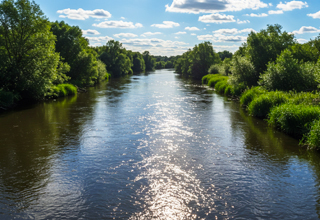
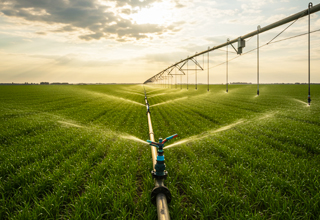
An ultrasonic open channel flow meter is an instrument that uses ultrasonic technology to measure the flow rate of liquids in open channels (such as rivers, canals, sewage channels, irrigation channels, etc.). It measures the liquid level in a non-contact manner and calculates the flow rate based on the geometric shape of the channel (such as weirs, channels, etc.).
Working Principle
Level Measurement: The sensor (ultrasonic transducer) is installed above the channel and emits ultrasonic pulses toward the water surface. When the ultrasonic waves encounter the water surface, they are reflected and received by the sensor. By measuring the time it takes for the ultrasonic waves to travel from emission to reception (i.e., transit time), the distance from the sensor to the water surface can be calculated. Since the installation height of the sensor is known, the height of the water surface (level) can be determined.
Flow Calculation: Flow calculation depends on the predefined relationship between channel geometric parameters and liquid level. Typically, specific hydraulic structures such as weirs (e.g., V-weir, rectangular weir, Cipoletti weir, etc.) or flumes (e.g., Parshall flume, Venturi flume, etc.) are installed in open channels. These structures have specific liquid level-flow relationship curves or formulas. The flow meter calculates the current flow rate based on the measured liquid level values and these predefined relationships.
Main Components
Ultrasonic Sensor (Transducer): Responsible for emitting and receiving ultrasonic signals to measure the liquid level. Typically installed above the channel to avoid direct contact with the liquid.
Signal Processing Unit (Transmitter/Controller): Receives signals from the sensor, processes the signals, calculates the liquid level and flow rate, and displays the results or outputs them to other systems.
Temperature Sensor (Optional): The speed of sound in air is affected by temperature. To improve measurement accuracy, some flow meters are equipped with temperature sensors to correct the speed of sound.
Mounting Bracket and Housing: Used to secure the sensor and protect electronic components.
Advantages
Non-contact measurement: The sensor does not come into direct contact with the liquid, avoiding issues such as corrosion, wear, and blockage by contaminants, thereby reducing maintenance costs.
Easy installation: Typically, the sensor only needs to be installed above the channel, without altering the channel structure.
Suitable for various liquids: It has low requirements for the properties of the liquid and can be used for clean water, wastewater, and liquids containing a small amount of suspended solids.
Wide measurement range: It can accommodate a large range of flow changes.
Low maintenance costs: With no moving parts, maintenance requirements are minimal.
Resistant to silt, suspended solids, and oils: Non-contact measurement provides strong resistance to these factors.
Suitable for large pipelines, irrigation channels, rivers, and large streams.
Limitations
Susceptible to environmental factors: Heavy rain, fog, strong winds, dust, or foam in the air may interfere with ultrasonic signals, affecting measurement accuracy.
Requires knowledge of channel geometry: Pre-existing knowledge and setup of channel geometric parameters and the liquid level-flow rate relationship are necessary.
Accuracy may be inferior to contact-type instruments: In certain complex operating conditions, accuracy may be inferior to contact-type instruments such as electromagnetic flow meters or vortex flow meters.
Initial cost may be higher: Compared to some simple level gauges, the initial investment for ultrasonic open-channel flow meters may be higher.
Performance depends on fluid conditions: In fluids containing a large amount of solids or bubbles, the transmissive model may fail.
Applications
Water resource management: Monitoring water volume in rivers, reservoirs, and canals.
Irrigation and agriculture: Flow control and measurement in irrigation channels.
Wastewater treatment plants: Flow monitoring at inlet and outlet points.
Rainwater drainage monitoring: Flow monitoring in urban rainwater drainage pipelines.
Industrial wastewater discharge monitoring: Flow measurement of wastewater discharged by industrial enterprises.
Environmental Monitoring: Monitoring of flow rates in surface water bodies.
Hydroelectric Power Plants: Monitoring of flow rates in tailrace channels.
Installation Considerations
Select an appropriate installation location: Avoid installing in areas with turbulent water flow, significant surface fluctuations, or foam formation.
Ensure the sensor is perpendicular to the water surface: To ensure effective reflection of ultrasonic signals.
Avoid obstacles: There should be no obstacles below the sensor that could block ultrasonic signals.
Consider temperature effects: If high-precision measurement is required, temperature compensation should be considered.
Follow the manufacturer’s instructions for installation and setup: Ensure that the channel’s geometric parameters and the water level-flow rate relationship are correctly input.
| Brand | Apure |
|---|---|
| Model | MQ6000 |
| Measure range | 0.1L/s~10m3/s |
| Cumulative flow | 999999999999m3 |
| Range of measuring distance | 0~3m (Blind spot: 0.3~0.5m) |
| Accuracy of measuring distance | 0.3% |
| Flow accuracy | 1% (Depends on weir type) |
| Resolution of measuring distance | 1mm |
| Analog output | 4~20mA |
| Power supply | DC12V, DC24V/AC220V,or customized. Build-in lighting-proof equipment |
| Protection level | IP67 (Fully enclosed is IP68) |