
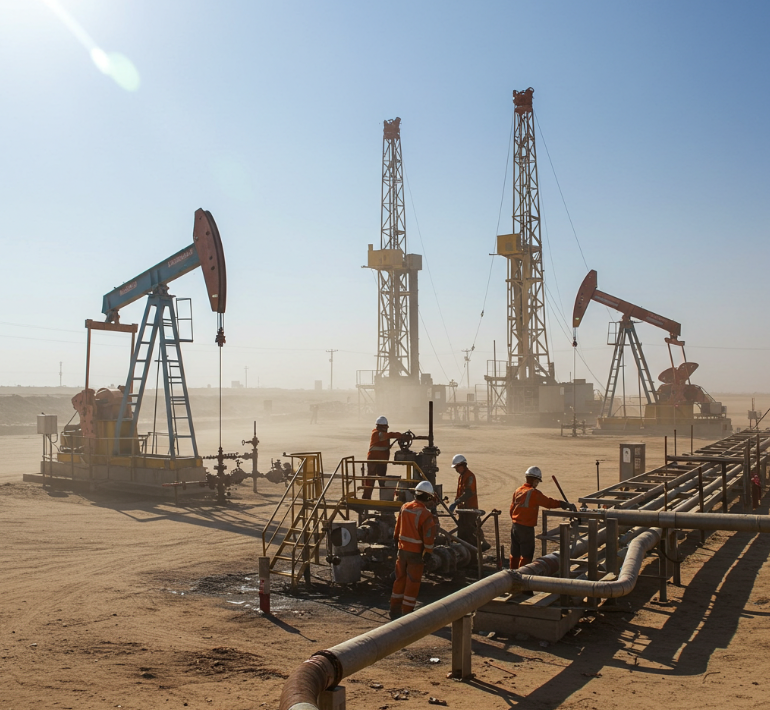
Oil and natural gas are the cornerstones of modern society’s energy supply. From underground oil and gas wells to the hands of end-users, they undergo a long and complex process of transportation and processing. In this process, oil and gas flow meters play a crucial role, acting as the “meters” on the energy arteries, precisely recording every drop of oil and every cubic meter of gas that flows through. Today, we will take a closer look at these unsung heroes of the energy industry.

The Importance of Oil and Gas Flow Meters
In the oil and gas industry, precise flow measurement is not merely about recording numbers; it directly impacts:
- Economic Trade: Oil and gas are key commodities in global trade, and accurate measurement is the foundation of fair transactions, directly affecting the economic interests of both buyers and sellers.
- Production Management: By monitoring oil and gas well production, pipeline transportation volumes, and refinery processing capacities, production processes can be optimized to enhance efficiency.
- Safety and Environmental Protection: Abnormal fluctuations in flow data may indicate safety hazards such as leaks. Timely monitoring helps ensure production safety and environmental protection.
- Regulatory Compliance: Governments worldwide impose stringent regulations on oil and gas extraction, transportation, and sales. Accurate flow measurement is a critical safeguard for meeting these regulatory requirements.
Types of Oil and Gas Flow Meters
Operating conditions in the oil and gas industry are often highly complex, involving challenges such as high pressure, high temperature, corrosive media, and multiphase flow. Therefore, various types of flow meters are required to address these diverse needs. The following are some common types of oil and gas flow meters:
- Differential Pressure Flow Meters: These are among the most traditional and widely used flow meters in the oil and gas industry, including orifice plate flow meters, Venturi flow meters, and Pitot tubes. They calculate flow rate by measuring the pressure difference generated when the fluid flows through the throttling device.
- Advantages: Simple structure, relatively low cost, and high reliability.
- Disadvantages: Accuracy may be affected by the state of the fluid and installation conditions, and there is significant pressure loss.
- Turbine Flow Meters: These meters calculate flow rate by measuring the rotation speed or number of rotations of the internal turbine driven by the fluid.
- Advantages: High accuracy, wide range ratio, suitable for clean liquids and gases.
- Disadvantages: Certain requirements for fluid cleanliness, moving parts may experience wear.
- Positive Displacement Flow Meters: Calculate flow rate by precisely measuring the number of times the fluid passes through a chamber of known volume. Common types include oval gear flow meters and scraper flow meters.
- Advantages: Very high measurement accuracy, especially suitable for high-viscosity liquids.
- Disadvantages: Complex structure, higher cost, and significant pressure loss.
- Ultrasonic Flow Meters: Utilize the propagation characteristics of ultrasonic waves in fluids to measure flow rate. Common types include the time-of-flight method and the Doppler method.
- Advantages: Non-contact measurement, no pressure loss, capable of measuring liquids and gases, suitable for large-diameter pipelines.
- Disadvantages: Accuracy may be affected by the fluid medium and flow conditions.
- Coriolis Mass Flow Meters: Directly measure the mass flow rate of the fluid, unaffected by fluid density, temperature, and pressure.
- Advantages: Extremely high measurement accuracy, capable of measuring various fluids, including multiphase flows.
- Disadvantages: Complex structure, very high cost.
- Vortex Flow Meters: When a fluid flows past an obstacle, vortices are generated, and the frequency of these vortices is directly proportional to the flow velocity.
- Advantages: Simple structure, wide measurement range, and minimal pressure loss.
- Disadvantages: Certain requirements for fluid cleanliness.
Challenges and Technological Developments in Oil and Gas Flow Measurement
The unique characteristics of the oil and gas industry present numerous challenges for flow measurement:
- Harsh operating conditions: High pressure, high temperature, low temperature, corrosive media, etc.
- Complex fluid composition: Crude oil and natural gas are often mixtures of multiple substances and may contain solid particles and moisture.
- Multiphase flow issues: During oil and gas production and transportation, multiphase flows involving oil, gas, and water often coexist, making precise measurement extremely challenging.
- High precision requirements: Trade handover and other processes demand extremely high measurement accuracy.
To address these challenges, oil and gas flow meter technology is continuously evolving:
- Multiphase flow meters: Specifically designed to measure the flow of multiphase mixtures of oil, gas, and water, these are currently a hot area of research.
- Smart flow meters: Integrated with sensors, processors, and communication modules, these enable remote monitoring, fault diagnosis, and data analysis.
- High-precision flow meters: Continuously improving measurement accuracy to meet the high requirements of applications such as trade handover.
- New materials and structures: Adopting more corrosion-resistant and high-temperature-resistant new materials and more optimized structural designs to adapt to more severe operating conditions.
How to select the appropriate oil and gas flow meter?
Selecting the appropriate oil and gas flow meter requires comprehensive consideration of the following factors:
Fluid type and properties
- Is it oil or gas? Oil is a liquid, while gas is a gas, and their physical properties are completely different, requiring different types of flow meters.
- Composition: Is it pure oil/gas, or a mixture (e.g., oil containing water or impurities, or natural gas containing hydrogen sulfide or carbon dioxide)?
- Viscosity: The viscosity of oil can vary greatly, and high-viscosity fluids require special flow meters.
- Corrosiveness: Does the fluid contain corrosive substances (such as H₂S or CO₂), which can affect the material selection for the flow meter?
- Cleanliness: Does the fluid contain solid particles or impurities? This can affect the lifespan and accuracy of flow meters with moving parts (such as turbine flow meters).
- Density and compressibility: Gases are compressible fluids whose density varies with temperature and pressure. Therefore, gas flow meters typically require temperature and pressure compensation to measure mass flow or standard volume flow.
Measurement requirements
- Measurement type: Do you need to measure volumetric flow or mass flow? In the oil and gas industry, mass flow is typically more meaningful as it is unaffected by temperature and pressure changes.
- Accuracy Requirements: How high is the accuracy requirement? For example, flow meters used for custody transfer typically require extremely high accuracy (e.g., 0.1%), while process monitoring may only require lower accuracy (e.g., 1% or 2%).
- Flow Range (Turndown Ratio): What is the range of minimum and maximum flow changes in the pipeline? The flow meter must maintain accuracy across the entire range.
- Pressure Drop Requirements: Is the pressure loss caused by installing the flowmeter within an acceptable range? Some flowmeters may cause significant permanent pressure drop.
Process Conditions
- Operating Pressure: The maximum and minimum operating pressures in the pipeline.
- Operating Temperature: The maximum and minimum operating temperatures of the fluid.
- Environmental Conditions: Is the flow meter installed indoors or outdoors? Are there environmental factors such as vibration, dust, humidity, or extreme temperatures? Is an explosion-proof rating (ATEX/IECEx) required?
- Pipe Size and Installation Space: The diameter and material of the pipe, as well as whether there is sufficient straight pipe length (Upstream/Downstream Straight Run) to ensure accurate operation of the flow meter.
Cost and Maintenance
- Initial Investment Cost: The purchase price of the flow meter.
- Installation costs: Is the installation complex? Are special tools required?
- Operating costs: Maintenance costs, calibration frequency and costs, energy consumption (if external power is required).
- Service life: The expected service life of the flow meter.
- Maintenance requirements: Are there any moving parts? Is regular cleaning or replacement of parts required?