
An electromagnetic flow meter is an instrument that measures the volumetric flow rate of conductive liquids using Faraday’s law of electromagnetic induction. It provides obstruction-free measurement with minimal pressure loss and is suitable for corrosive media such as acids, alkalis, salts, and slurries. Unlike mechanical flowmeters, the measurement method of electromagnetic flowmeters is unaffected by changes in the temperature, pressure, viscosity, or density of the flowing medium.


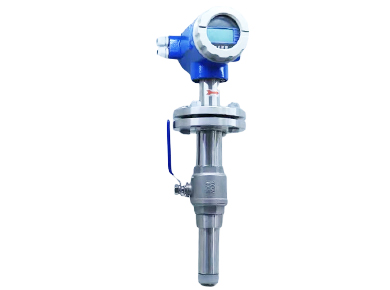
How does an electromagnetic flowmeter work?
The working principle of an electromagnetic flowmeter is based on Faraday’s law of electromagnetic induction. When a conductor moves through a magnetic field and cuts through the magnetic field lines, an electromotive force (i.e., voltage) is generated at the two ends of the conductor. Applying this law to flow measurement:
- Generating a magnetic field: The sensor inside the electromagnetic flowmeter contains coils. When energized, these coils generate a constant magnetic field around the measurement pipe.
- Conductive fluid as the “conductor”: Only conductive liquids can be measured by an electromagnetic flowmeter. When these conductive liquids (such as water, wastewater, acid-base solutions, slurry, etc.) flow through the sensor, they effectively move through the magnetic field in a manner that “cuts through the magnetic field lines.”
- Generating an electromotive force: Due to the flow of the liquid, an electromotive force (voltage) is induced on the two electrodes on either side of the pipe.
- Electromotive force is proportional to flow velocity: The key point is that the magnitude of the induced electromotive force is directly proportional to the average flow velocity of the fluid. In other words, the faster the fluid flows, the higher the voltage generated; the slower the flow, the lower the voltage.
- Signal conversion: The flowmeter’s transmitter detects and amplifies this weak electromotive force signal, then converts it into a standard electrical signal (such as a 4-20mA current signal or pulse signal), ultimately displaying the flow rate value.
Advantages
- No obstructions, no pressure loss: There are no moving parts or throttling elements inside the measuring tube, allowing the fluid to flow freely with minimal pressure loss.
- Suitable for complex fluids: Insensitive to changes in fluid properties (such as temperature, pressure, density, and viscosity), it can measure conductive liquids containing solid particles, fibers, or slurries.
- Accurate and reliable measurement: High accuracy, unaffected by changes in fluid temperature, pressure, density, or viscosity.
- Low maintenance: Due to the absence of moving parts, wear is minimal, resulting in lower maintenance costs.
- Bidirectional measurement: Can measure fluid flow in both forward and reverse directions.
Applications
Widely used in the chemical, light industry, water treatment, environmental protection, and other industries, it is used to measure the flow of various conductive liquids such as acid, alkali, salt solutions, pulp, and slurry. However, it should be noted that the integrated electromagnetic flowmeter has certain requirements for the operating environment and is not suitable for harsh environments such as high temperatures, high humidity, or strong corrosion. When selecting, it is necessary to evaluate based on the specific operating conditions.