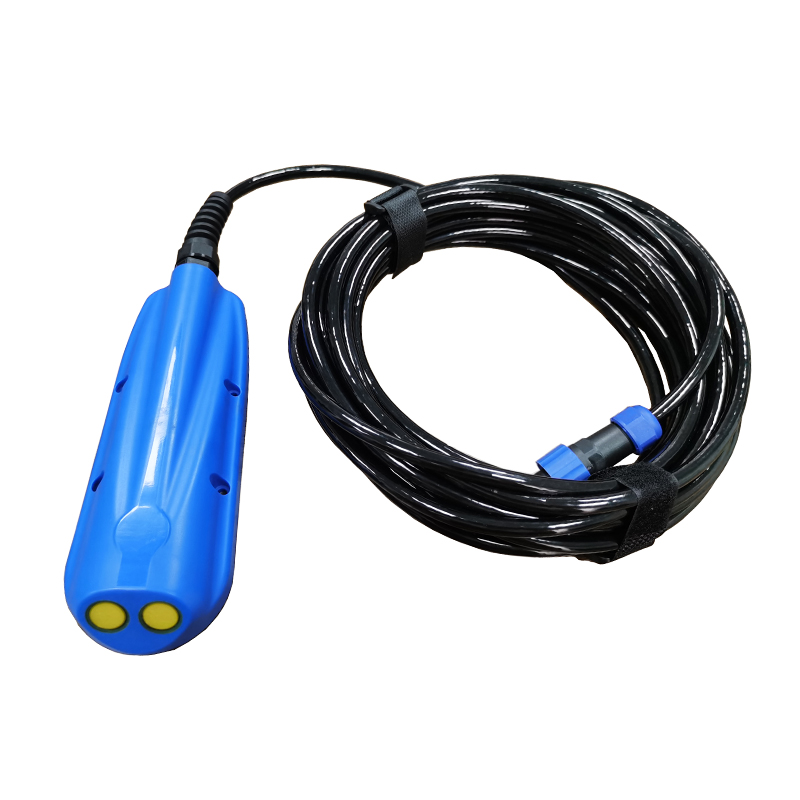
An ultrasonic Doppler flowmeter is an instrument that uses the Doppler effect principle to measure liquid flow. Unlike ultrasonic time-of-flight flowmeters (also known as transit time flowmeters), Doppler flowmeters do not measure the propagation time of ultrasonic waves. Instead, they calculate the velocity of the fluid by measuring the frequency shift of the ultrasonic waves, and then calculate the flow rate.
Working Principle
Ultrasonic Wave Transmission: The sensor emits a beam of ultrasonic waves at a specific frequency into the flowing liquid.
Frequency Shift: The liquid must contain substances capable of reflecting ultrasonic waves, such as suspended particles or bubbles. When these moving reflective objects encounter the ultrasonic waves and reflect them back, the frequency of the ultrasonic waves changes.
Doppler Shift: There is a difference between the received ultrasonic wave frequency and the transmitted frequency, which is referred to as the “Doppler shift.” The magnitude of this shift directly reflects the fluid’s velocity.
Calculating Velocity and Flow Rate: The flowmeter calculates the fluid’s velocity based on the detected Doppler shift. Once the velocity is known, combined with the pipe’s cross-sectional area, the total fluid flow rate can be determined.
Main Types
Clamp-on/Non-invasive
The sensor is directly clamped onto the outer wall of the pipe, without the need to cut open the pipe or halt production.
Easy to install, no pressure loss, suitable for corrosive or hazardous liquids.
Measurement accuracy may be affected by pipe material, thickness, and lining.
Certain requirements for the concentration of reflective objects in the liquid.
Insertion/Wetted
The sensor probe is directly inserted into the fluid through an opening in the pipe.
Direct contact with the fluid typically yields stronger reflection signals.
Suitable for applications requiring higher accuracy or where clamp-on sensors are unsuitable.
Installation requires pipe cutting, which may cause minor pressure loss.
Advantages
Non-contact measurement (clamp-on): No need to cut the pipeline, easy to install and maintain, and does not come into contact with corrosive or abrasive fluids.
No pressure loss: Does not obstruct fluid flow, thus causing no additional pressure loss.
Wide applicability: Suitable for non-homogeneous fluids containing suspended solids, bubbles, or particles, which is a limitation of time-of-flight flow meters.
Cost-effective: In certain applications, particularly large pipelines, installation and maintenance costs may be lower than other flow meters.
Portability (clamp-on): Easy to move between different measurement points for temporary measurements.
Disadvantages
Fluid medium requirements: Must contain sufficient concentrations of reflective particles (particles, bubbles, etc.). For very pure fluids (e.g., drinking water), Doppler flow meters may not function or have low accuracy.
Limited measurement accuracy: Compared to time-of-flight or electromagnetic flow meters, Doppler flow meters typically have lower measurement accuracy, especially in non-homogeneous fluid media or when reflective particle concentrations are unstable.
Affected by flow velocity distribution: Measurement results may be influenced by fluid profiles (laminar flow, turbulent flow) and uneven distribution of reflective particles.
Pipe wall/lining effects (clamp-on): Pipe material, thickness, lining, and the quality of the acoustic coupling agent all affect signal strength and measurement accuracy.
Not suitable for gases and steam: Primarily designed for liquid flow measurement.
Applications
Ultrasonic Doppler flow meters are commonly used in the following fields:
Wastewater treatment: Measuring untreated or preliminarily treated wastewater, sludge, crude oil, and other liquids containing suspended solids.
Mining and metallurgy: Measuring slurry, coal slurry, mud, and other highly abrasive, high-concentration media.
Chemical industry: Chemical liquids containing particles or bubbles.
Power industry: Cooling water, ash slurry, etc.
Pulp and paper industry: Pulp slurry.
Environmental monitoring: Monitoring of wastewater containing suspended solids at certain discharge points.
| Brand | Apure |
|---|---|
| Model | Type |
| Flux range | 0-9999999 (Full eight cleared and the cumulative number pius 1) |
| Instant flux | 10L/s~100mr/s ((based on wire type and size) Velocity range: 0.01~±32m/s (Time difference method) , 0.05~ ±5m/s (Doppler method) |
| Accuracy | ±5% (Level method) 、±1% ( Time difference method). ±2% (Doppler method) |
| Transducer | Blind area: 0.06–2m Range:1、2、5、8、10、12、15、20、25、30、35、40m |
| Display | LCD |
| Power | AC220Vor DC12~24V consumption: 5W |
| Input (optional) | Sensor:4~20mA、0~20mA、1~5V、0~5V or RS485 |
| Output | One or two 4-20mA (one is standard) RS485/232 (Modbus)(optional) Relay ( AC:5A 250V DC:10A 120V, 4relays available) |