
An ultrasonic flow meter is an instrument that uses ultrasonic technology to measure the flow rate of fluids (liquids, gases, or steam). It calculates the velocity of the fluid by transmitting and receiving ultrasonic signals, thereby determining the flow rate.


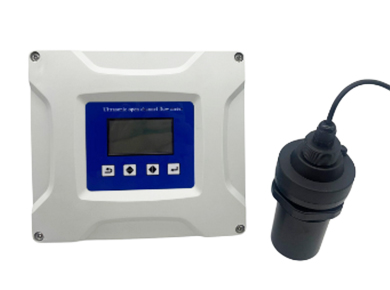

How does an ultrasonic flow meter work?
Time-of-flight method
It is based on the difference in the speed of ultrasonic waves traveling in the same direction and in the opposite direction in a fluid. The flowmeter alternately transmits and receives ultrasonic waves through two transducers to measure the time difference between the signals traveling in the same direction and in the opposite direction. Due to the presence of flow velocity, the time for the same-direction signal is shortened, while the time for the opposite-direction signal is lengthened. The microprocessor utilizes this small time difference, combined with the pipe size, to precisely calculate the average flow velocity of the fluid and thereby determine the flow rate. This method requires a high degree of fluid cleanliness and is suitable for measuring pure liquids and gases.
Doppler Method
It utilizes the Doppler effect, where the frequency of the reflected signal changes when ultrasonic waves encounter moving suspended particles, bubbles, or turbulence in the fluid. The flowmeter emits ultrasonic waves at a fixed frequency. When these waves are reflected back by objects in the fluid, their frequency shifts. By measuring this frequency shift, the fluid’s velocity can be calculated and converted into flow rate. The Doppler method is more suitable for measuring “dirty” liquids containing impurities, such as wastewater or slurry, as it relies on reflective objects within the fluid to function.
Advantages
The outstanding advantage of ultrasonic flow meters lies in their non-contact measurement capability. Many models do not require pipe cutting and can be directly installed externally, thereby avoiding pressure loss and preventing fluid wear on the sensor. This makes installation simple, maintenance costs low, and enables measurement of corrosive fluids. Additionally, it can accurately measure bidirectional flow and is widely applicable to various liquids and gases.
Applications
In water and wastewater treatment, it is used to monitor the flow of tap water, sewage, and pure water. In the petrochemical industry, it can measure crude oil, refined oil, and various chemicals. In addition, it is also an important tool for energy management, used to monitor cooling water, heating systems, and the overall energy consumption of factories or buildings.