
An ultrasonic flowmeter is an instrument that uses ultrasonic technology to measure the velocity and flow rate of fluids in pipes or open channels. It works by emitting ultrasonic signals into the fluid and analyzing the propagation characteristics of these signals in the fluid (such as propagation time or frequency changes) to calculate the fluid velocity and thereby determine the flow rate. Ultrasonic flowmeters have become a leading technology, providing a non-invasive and reliable solution for measuring the flow rates of various liquids and gases.


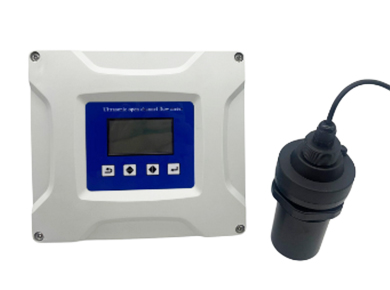

Working Principle of Ultrasonic Flow Meters
Ultrasonic flow meters primarily operate based on the following two principles:
Transit Time Method (Transit Time or Time-of-Flight)
- Two ultrasonic sensors are installed on opposite sides of the pipeline.
- One sensor emits an ultrasonic pulse upstream (against the flow direction), while the other sensor emits the same pulse downstream (with the flow direction).
- Due to the flow of the fluid, the propagation speed of the ultrasonic waves in the downstream direction increases, while the propagation speed in the upstream direction decreases.
- The flow meter measures the time difference between the two ultrasonic pulses as they propagate through the pipe.
- This time difference is directly proportional to the fluid’s flow velocity. The higher the flow velocity, the greater the time difference.
- By combining the flow velocity and the cross-sectional area of the pipe, the volumetric flow rate can be calculated.

Doppler Effect
- One or more ultrasonic sensors emit a beam of ultrasonic waves into the flowing liquid.
- Suspended particles, bubbles, or turbulence in the fluid reflect or scatter these ultrasonic waves.
- Since these scattering particles are in motion, the frequency of the reflected or scattered ultrasonic waves changes, and this frequency change is called the Doppler shift.
- The magnitude of the Doppler shift is directly proportional to the velocity of the scattering particles in the fluid.
- The flowmeter calculates the fluid velocity by measuring this shift, and then calculates the flow rate.

In summary, ultrasonic flowmeters determine the fluid velocity by measuring the time difference in the propagation of ultrasonic waves in the fluid (time-of-flight method) or the frequency change (Doppler effect), thereby calculating the flow rate.
Applications
- Water and wastewater treatment industry:
Measure the flow rate of tap water, raw water, recycled water, and purified water.
Monitoring the inflow, outflow, and sludge flow rates at wastewater treatment plants.
Measuring industrial wastewater discharge volumes.
Water flow monitoring and scheduling for water conservancy projects.
- Oil and Gas Industry:
Measuring the flow rates of crude oil, natural gas, liquefied petroleum gas (LPG), and liquefied natural gas (LNG).
Flow monitoring and leak detection in oil and gas pipelines.
Flow measurement on offshore platforms and oil storage facilities.
Measure the flow rate of various process fluids in refineries and petrochemical plants.
- Chemical Industry:
Measure the flow rate of various corrosive liquids such as acids, alkalis, salt solutions, and organic solvents.
Monitor material flow in reactors, mixers, and other equipment.
Used for precise measurement in the fine chemicals and pharmaceutical industries.
- Food and Beverage Industry:
Measure the flow rate of sanitary-grade liquids such as milk, juice, beer, and beverages.
Used for ingredient and filling control in food processing.
- HVAC Industry:
Measuring water flow in heating and cooling systems for energy management and billing.
- Power Industry:
Measuring cooling water flow in power plants.
Monitoring boiler feedwater and steam flow.
Used for specific fluid measurement in nuclear power plants.
- Metallurgy Industry:
Measuring the flow of cooling water, process water, and certain slurries.
- Pulp and Paper Industry:
Measuring the flow of fluids such as pulp, black liquor, and white liquor.
Used for additive metering in the papermaking process.
- Shipbuilding Industry:
Measuring the flow of fuel oil, lubricating oil, cooling water, ballast water, etc.
- Agriculture:
Monitoring water flow in irrigation systems.
Measuring the application rate of liquid fertilizers and pesticides.
- Medical industry:
Liquid flow control for medical devices.
In some cases, measuring blood flow velocity (Doppler ultrasound).
- Other industrial fields:
Applications in pharmaceuticals, semiconductors, environmental monitoring, and other fields.
In summary, ultrasonic flow meters are a highly popular and effective choice for any application requiring the measurement of liquid or gas flow, especially in scenarios where non-invasive, pressure-loss-free measurement or the measurement of specific fluids (e.g., those containing suspended particles) is required. Different types of ultrasonic flow meters (e.g., time-of-flight and Doppler methods) and various installation methods (e.g., clamp-on, insertion, and in-line) enable them to adapt to a wide range of application requirements.
Calibration
Calibration considerations for different types of ultrasonic flow meters:
- Time-of-flight ultrasonic flow meters: During calibration, it is essential to ensure the uniformity and cleanliness of the fluid to avoid interference from bubbles and suspended particles on the ultrasonic signal. For clamp-on time-of-flight flow meters, the material of the pipeline, wall thickness, and the coupling condition between the sensor and the pipeline significantly impact the calibration results.
- Doppler ultrasonic flow meters: During calibration, it is essential to ensure that the fluid contains sufficient and uniformly distributed scatterers (particles or bubbles) to generate reliable Doppler signals. The characteristics of the scatterers (such as size and density) also affect calibration results.
Measurement accuracy
Generally, the accuracy range of ultrasonic flowmeters can vary from ±0.5% to ±5% or higher, depending on the following factors:
Flowmeter type and design
- Transit Time Flowmeters: Under ideal conditions (uniform, clean fluid, sufficient straight pipe sections), high accuracy can be achieved, typically around ±0.5% to ±1%, with some high-end products achieving even higher accuracy.
- Doppler flow meters: Their accuracy is generally lower than that of transit time flow meters, typically ranging from ±1% to ±5% or higher. Accuracy is more susceptible to the characteristics of particles or bubbles in the fluid.
How to Improve the Measurement Accuracy of Ultrasonic Flow Meters
- Select the appropriate flow meter type and model to suit the specific fluid and application scenario.
- Ensure sufficient straight pipe sections.
- Properly install the sensors and ensure good coupling (for clamp-on types).
- Accurately set the instrument parameters.
- Regularly calibrate the instrument.
- Consider the effects of changes in fluid temperature and pressure and perform necessary compensation.