
A thermal mass flow meter is a widely used instrument for measuring the mass flow rate of gases in industrial and environmental applications. Unlike traditional flow meters that infer flow from velocity or pressure, thermal mass flow meters measure mass flow directly, without the need for temperature or pressure compensation. Understanding the working principle of thermal mass flow meters helps engineers select the right solution for applications such as compressed air monitoring, natural gas measurement, and emission control.
Thermal Mass Flow Meter Basic Measurement Principle
The working principle of a thermal mass flow meter is based on heat transfer. When a heated sensor is exposed to a flowing gas, part of the heat is carried away by the gas. The amount of heat removed is directly related to the mass flow rate of the gas.
In simple terms:
Higher gas mass flow → more heat removed from the sensor
By measuring this heat loss, the instrument can accurately determine the gas mass flow.
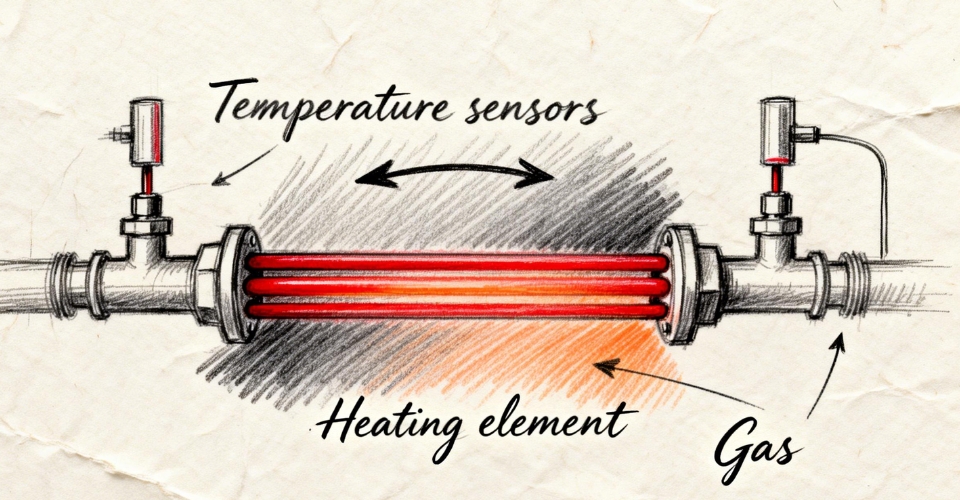
Sensor Structure
A typical thermal mass flow meter consists of two temperature sensors:
- Heated sensor (active sensor)
This sensor is electrically heated above the gas temperature.
- Reference sensor
This sensor measures the actual gas temperature and is not heated.
Both sensors are positioned directly in the gas stream, either in an inline or insertion-type configuration.
How the Measurement Works?
When gas flows through the meter:
- The heated sensor transfers heat to the flowing gas.
- As flow increases, heat is removed more rapidly.
- The electronics supply additional power to maintain a constant temperature difference between the heated sensor and the reference sensor.
- The electrical power required to maintain this temperature difference is proportional to the mass flow rate of the gas.
This relationship allows the meter to calculate mass flow directly.
Measurement Methods
Thermal mass flow meters typically use one of two operating modes:
Constant Temperature Difference (CTD)
- Maintains a fixed temperature difference between sensors
- Measures the power needed to sustain this difference
- Most commonly used in industrial applications due to stability and accuracy
Constant Power
- Applies a fixed heating power
- Measures the resulting temperature difference
- Less common in modern industrial designs
Why It Measures Mass Flow Directly?
Heat transfer depends on the number of gas molecules passing the sensor per unit time, which is directly related to mass flow rather than volumetric flow. As a result, thermal mass flow meters can output mass-based units such as:
- kg/h
- Nm³/h
- Sm³/h
This eliminates the need for separate pressure and temperature compensation.
How Does Its Operating Principle Differ From Other Types Of Flow Meters?
In contrast, differential pressure, vortex, turbine, ultrasonic, and electromagnetic flow meters measure volumetric flow. These meters calculate flow based on pressure loss, vortex frequency, rotor speed, sound transit time, or induced voltage (for conductive liquids), and then convert volume to mass using additional temperature and pressure data. Electromagnetic flow meters are limited to conductive liquids and cannot measure gases, while thermal mass flow meters are specifically designed for gas applications.
Typical Applications
Thermal mass flow meters are widely used in gas measurement applications, including:
- Compressed air consumption monitoring
- Natural gas and biogas measurement
- Nitrogen, oxygen, and hydrogen flow measurement
- Flue gas and exhaust gas monitoring
- Leak detection and energy management systems
They are particularly effective in low-flow and large-diameter pipe applications.
Advantages of Thermal Mass Flow Meters
- Direct mass flow measurement
- No moving parts, resulting in low maintenance
- Minimal pressure loss
- High sensitivity at low flow rates
- Long-term measurement stability
Limitations and Considerations
Despite their advantages, thermal mass flow meters have some limitations:
- Gas composition must remain relatively stable
- Not suitable for wet gas or gas with heavy condensate
- Accuracy can be affected by dust or oil contamination
- Calibration is gas-specific
Proper application evaluation is essential to ensure optimal performance.
Summary
The thermal mass flow meter working principle relies on measuring heat loss from a heated sensor caused by gas flow. By directly correlating heat transfer with mass flow, thermal mass flow meters provide accurate, reliable, and efficient gas flow measurement across a wide range of industrial applications. When applied correctly, they are an excellent choice for modern process control and energy monitoring systems.
Apure provides practical flow measurement solutions you can trust—engineered for real industrial conditions. Contact us today to discuss your application or request technical support.