
In fluid mechanics, flow regimes are generally categorized into laminar flow and turbulent flow.
From a pure physics standpoint, we often discuss their velocity profiles, Reynolds numbers, and energy losses.
But in the world of flowmeters, the difference between laminar and turbulent flow is far more than an academic concept—it directly impacts measurement accuracy, instrument selection, and maintenance strategies.

Laminar Flow in Flow Measurement
Recap of Characteristics
In laminar flow, fluid moves in orderly parallel layers, with a parabolic velocity profile—fastest in the center and slowest near the pipe wall.
In pipe flow, Reynolds number 𝑅𝑒<2000 generally indicates laminar flow.

Measurement Impact
Differential Pressure Flowmeters (e.g., orifice plate, Venturi)
In laminar flow, the relationship between ΔP and flow rate tends toward linear. If the meter is calibrated under turbulent assumptions, significant errors may occur.
Positive Displacement Flowmeters
Ideal for laminar flow since the stable motion is less affected by turbulence.
Thermal Mass Flowmeters
Heat transfer is more predictable in laminar conditions, improving response stability.
Ultrasonic Flowmeters (transit-time, Doppler)
Parabolic velocity profiles in laminar flow can cause bias in single-path systems, requiring multi-path or profile compensation.


Turbine Flowmeters
In laminar flow, low momentum may cause unstable rotor motion and poor low-flow performance.


Typical Applications
- Microflow measurement (semiconductor gas delivery)
- High-viscosity fluids (lubricants, syrups)
- Medical liquid delivery (infusion pumps, syringe-based meters)
Turbulent Flow in Flow Measurement
Recap of Characteristics
Turbulent flow features chaotic fluctuations in velocity magnitude and direction, with eddies and intense mixing.
When 𝑅𝑒>4000, most pipe flows are turbulent.

Measurement Impact
Differential Pressure Flowmeters
Turbulent conditions fit Bernoulli-based flow coefficients better, yielding high accuracy in ΔP–flow relationships.
Vortex Flowmeters
Stable Kármán vortex shedding occurs in turbulent regimes, ensuring reliable frequency detection.


Electromagnetic Flowmeters
Turbulence promotes uniform magnetic induction, though it has limited impact compared to other factors.


Ultrasonic Flowmeters
Flatter velocity profiles in turbulence improve average velocity representation and accuracy.
Turbine Flowmeters
Turbulent flow provides stable torque to the rotor, enabling optimal performance at medium to high velocities.
Typical Applications
- Industrial water treatment (high flow rate, low viscosity)
- Power plant cooling water circuits
- Fire protection and municipal water distribution
Transitional Flow Challenges
In the range 2000<𝑅𝑒<4000, flow is unstable and may switch between laminar and turbulent.
For flowmeters, this is a high-risk zone:
- Differential pressure meters show significant errors
- Vortex meters may lose signal or show unstable frequencies
- Mass flowmeters may require density compensation
- Ultrasonic meters need complex profile correction
- Turbine meters may have unstable rotation rates
The engineering solution is often to adjust velocity or pipe diameter to avoid this range.
Using Reynolds Number to Identify Flow Regimes
The Reynolds number is the primary indicator for determining flow regime:

Pipe Flow Classification
Laminar: 𝑅𝑒<2000
Transitional: 2000≤𝑅𝑒≤4000
Turbulent: 𝑅𝑒>4000
Example Calculation
For water at 20°C (𝜌≈998 kg/m³, 𝜇≈0.001 Pa· s), pipe diameter 0.05 m, velocity 1 m/s:
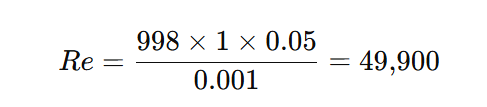
This is well above 4000 → typical turbulent flow.

Impact on Flowmeter Selection
- Turbulent conditions: Favor DP meters, vortex, electromagnetic, turbine, ultrasonic.
- Laminar conditions: Favor PD meters, mass meters, thermal meters, with low-Re compensation.
- Transitional conditions: Avoid if possible, or use multi-path ultrasonic or advanced signal processing meters.
Flowmeter–Flow Regime Compatibility
| Flowmeter Type | Best Flow Regime | Laminar Suitability | Turbulent Suitability | Typical Applications |
| Differential Pressure (Orifice, Venturi) | Turbulent | Poor | Excellent | Large industrial flows |
| Positive Displacement | Laminar | Excellent | Excellent | High-viscosity, low-flow |
| Vortex | Turbulent | Poor | Excellent | Steam, gas, water |
| Thermal Mass | Laminar/Turbulent | Excellent | Excellent | Gas delivery |
| Electromagnetic | Turbulent | Medium | Excellent | Water, wastewater, slurries |
| Ultrasonic | Turbulent | Medium | Excellent | Large-diameter water, oil, gas |
| Turbine | Turbulent | Poor | Excellent | Medium/high-velocity liquids, fuel |
Summary
In the realm of flow measurement, laminar and turbulent flows are more than just different physical states—they dictate meter selection, calibration strategies, and achievable accuracy.
And the Reynolds number is the key code for decoding your flow regime before making engineering decisions.
For instrumentation engineers, correctly identifying the flow type is the first step toward ensuring long-term stable and accurate measurement.
Understand Reynolds number, choose the right flowmeter.
Apure offers magnetic flowmeter, ultrasonic flowmeter, vortex flowmeter, turbine flowmeter, and differential pressure flowmeters — each optimized for its ideal flow regime. Please contact us if you need any assistance.