
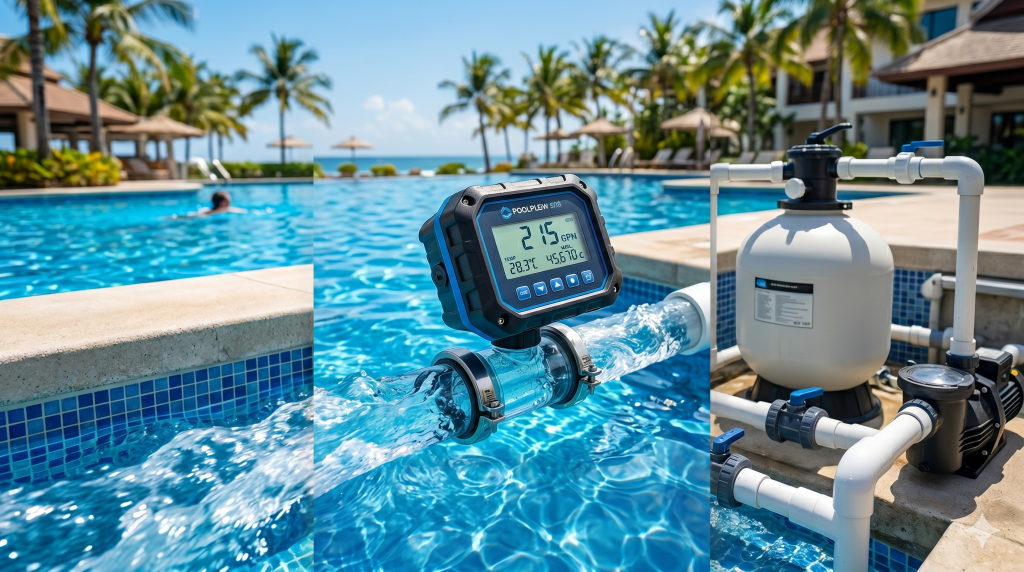
A swimming pool flow meter is a simple but important device that measures how much water is moving through a pool’s circulation system. It helps pool owners, operators, and service technicians confirm that the pump, filter, and sanitation system are working as intended.
What Is a Swimming Pool Flow Meter?
A swimming pool flow meter is a device that measures how much water passes through a pipe within a certain period of time. The reading is usually shown in:
- GPM: gallons per minute
- LPM: liters per minute
- m³/h: cubic meters per hour
In a pool system, the flow meter is commonly installed on the circulation pipeline, often near the pump, filter, heater, or dosing system. Its main purpose is to help users confirm whether the water flow is high enough for filtration and disinfection, but not so high that it damages equipment or reduces filtration performance.
Why It Is Important?
Pool water must circulate continuously to stay clean and safe. A flow meter helps you monitor that circulation and avoid common problems.
- It shows whether the pump is delivering the expected flow.
- It helps identify filter blockage or pipe restriction.
- It supports proper sanitizer distribution.
- It can help reduce energy waste caused by overpumping.
- It provides a quick visual check during maintenance or troubleshooting.
For commercial pools, flow monitoring can also support compliance with operational and health requirements.
Main Types of Swimming Pool Flow Meters
| Type of Swimming Pool Flow Meter | Description | Suitable Applications |
| Mechanical Flow Meter | Simple and cost-effective, but moving parts may need regular maintenance. | Basic pool flow indication |
| Rotameter | Uses a float inside a transparent tube for visual flow reading. | Small pool systems, simple circulation lines |
| Paddle Wheel Flow Meter | Uses a rotating paddle to measure water flow. Accuracy may be affected by dirt or debris. | Pool circulation systems |
| Turbine Flow Meter | Measures flow through a rotating turbine. Requires relatively clean water. | Clean pool water pipelines |
| Digital Flow Meter | Provides digital readings and signal output for monitoring or control. | Pool systems with alarms or automation |
| Magnetic Flow Meter | No moving parts and stable measurement for conductive pool water. | Large pools, public pools, water treatment systems |
| Ultrasonic Flow Meter | Measures flow using ultrasonic signals, with no moving parts. | Pool circulation and retrofit projects |
| Clamp-on Ultrasonic Flow Meter | Installed outside the pipe without cutting the pipeline. | Existing pipelines, temporary testing |
| Vortex Flow Meter | Detects vortices generated in the pipeline. More common in industrial water systems. | Large pool utility systems when conditions are suitable |


How Do Flow Meters Made Of Different Materials Differ In Terms Of Durability?
- Plastic: Generally offers better resistance to chlorine and corrosion, making it suitable for long-term exposure to pool disinfectants and humid environments; however, its strength and heat resistance are typically inferior to those of metal materials.
- Stainless Steel: High mechanical strength with superior resistance to pressure, impact, and temperature, making it suitable for more demanding operating conditions; however, corrosion risks must still be considered in certain chemical environments.
- Carbon steel: High strength but relatively poor corrosion resistance; more suitable for systems with low corrosion levels and not the first choice for chlorine-containing environments such as swimming pools.
- PVDF / Specialty plastic components: Commonly found in swimming pool flow meters as floats, internal parts, or wetted components; characterized by chemical resistance and good stability, making them suitable for long-term contact with treated water.
Durability Ranking:
- When considering only “overall durability in a chlorinated, persistently humid environment such as a swimming pool,” the general understanding is as follows:
- High-quality engineering plastics / PVDF-based wetted parts: Offer the best resistance to chemical corrosion and are well-suited for swimming pool water environments.
- Stainless steel: Typically offers good structural strength and longevity, but performance depends on specific water chemistry conditions and the risk of pitting corrosion.
- Standard plastics: Adequate corrosion resistance, but relatively poor long-term resistance to UV exposure, impact, and temperature extremes.
- Carbon steel: Generally the least favorable option for pool applications due to significant shortcomings in corrosion resistance.
How to Choose the Right One?
When selecting a swimming pool flow meter, focus on the system details first.
- Pipe size: Make sure the meter matches the pipe diameter.
- Flow range: Choose a model that covers your expected operating flow, not just the minimum.
- Installation position: Some meters require horizontal mounting or straight pipe runs.
- Material compatibility: The meter should tolerate chlorinated water and outdoor exposure.
- Readability: A clear scale or display makes maintenance easier.
- Use case: Residential pools, spa systems, and commercial pools may need different designs.
A good rule is to choose a meter that fits the normal operating range with some headroom on both ends. That gives you a more useful reading than a meter that is always near its limits.
Where It Helps Most?
A flow meter is especially useful in these situations:
- New pool startup and commissioning.
- Pump replacement or speed adjustment.
- Filter troubleshooting.
- Chemical feed verification.
- Energy optimization projects.
- Routine service checks.
For example, if a pool has weak circulation, a flow meter can help determine whether the issue is caused by the pump, the filter, or a restriction in the piping.
Swimming Pool Flow Meter Maintenance Tips
A flow meter should be checked regularly so its reading stays meaningful.
- Inspect for cracks, leaks, or discoloration.
- Confirm the meter is installed in the correct orientation.
- Clean the meter window or float area if debris builds up.
- Compare readings after pump or filter service.
- Replace worn or damaged parts as needed.
If the reading suddenly changes without any known system change, that is often a sign of blockage, air in the line, or equipment wear.
Summary
A swimming pool flow meter is a key instrument for maintaining stable pool circulation, filtration, chemical dosing, and equipment protection. By monitoring real-time water flow, pool operators can better control water quality, detect system problems, and improve operating efficiency.
For professional pool water treatment systems, choosing the right flow meter is not only about measuring flow. It is also about ensuring safer water quality, better filtration performance, and more reliable long-term operation.
Contact Apure Flowmeter to choose the right flowmeter for your swimming pool project.