
Ultrasonic Flow Meter Installation is a critical step that directly determines measurement accuracy, system stability, and long-term performance. Even the most advanced ultrasonic flow meter can produce unreliable data if installed incorrectly.
What Is an Ultrasonic Flow Meter?
An ultrasonic flow meter measures flow velocity using ultrasonic waves transmitted through a fluid. By analyzing the difference in transit time between upstream and downstream signals, the device calculates flow rate accurately and non-invasively.


Types of Ultrasonic Flow Meter Installation
Clamp-On Installation
Clamp-on ultrasonic flow meters are mounted externally on the pipe without cutting or interrupting flow.
Advantages:
- No pipe damage
- Easy installation
- Ideal for retrofit projects
- Low maintenance
Best for:
- Water treatment plants
- Temporary measurements
- Large pipelines
Inline Installation
Inline (or insertion/flanged) ultrasonic flow meters are installed directly into the pipeline.
Advantages:
- Higher accuracy
- Better signal stability
Best for:
- Permanent installations
- High-precision industrial processes
Selecting the Right Installation Location
Choosing the correct installation point is essential.
Key requirements:
- Ensure the pipe is completely full
- Avoid high air content areas
- Avoid sediment accumulation zones
Straight pipe requirements:
- Upstream: ≥ 10D
- Downstream: ≥ 5D
(D = pipe diameter)
Avoid installing near:
- Pumps
- Valves
- Elbows or bends
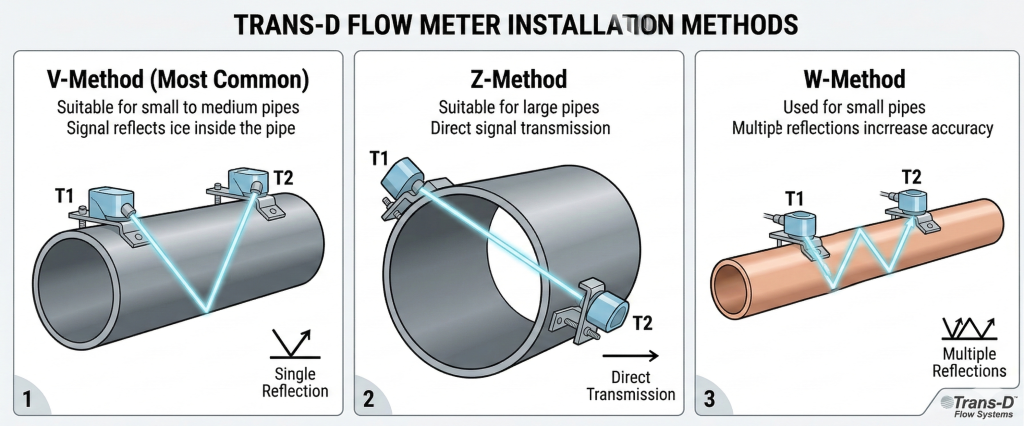
Transducer Installation Methods
The arrangement of transducers determines signal quality and measurement accuracy.
V-Method (Most Common)
- Suitable for small to medium pipes
- Signal reflects once inside the pipe
Z-Method
- Suitable for large pipes
- Direct signal transmission
W-Method
- Used for small pipes
- Multiple reflections increase accuracy
Installation Procedure (Step-by-Step)
Step 1: Surface Preparation
- Clean pipe surface thoroughly
- Remove rust, paint, or coating
- Smooth uneven surfaces
Step 2: Apply Coupling Agent
- Use ultrasonic coupling gel
- Ensure no air gaps between transducer and pipe
Step 3: Install Transducers
- Align according to selected method (V/Z/W)
- Maintain accurate spacing
Step 4: Wiring Connection
- Follow manufacturer wiring diagram
- Ensure proper grounding
- Avoid electromagnetic interference
Step 5: Parameter Setup
Input accurate system data:
- Pipe material
- Outer diameter
- Wall thickness
- Fluid type
- Temperature
Commissioning and Verification
After installation:
- Check signal strength and signal quality
- Verify readings against:
- Existing flow meters
- Theoretical calculations
Stable signals indicate correct installation.
Common Installation Mistakes
Avoid these frequent errors:
- Installing too close to flow disturbances
- Incorrect transducer spacing
- Poor surface preparation
- Lack of coupling gel
- Incorrect parameter input
- Air bubbles inside the pipe
Applications of Ultrasonic Flow Meters
Ultrasonic flow meters are widely used in:
- Water and wastewater treatment
- Industrial process control
- HVAC systems
- Irrigation systems
- Chemical processing
Tips for Better Performance
- Install on horizontal pipes when possible
- Avoid top-mounted positions (air accumulation)
- Prefer side mounting (3 or 9 o’clock position)
- Regularly check signal strength
- Recalibrate if fluid conditions change
Summary
Proper Ultrasonic Flow Meter Installation is essential to ensure accurate, stable, and reliable flow measurement. By carefully selecting the installation location, correctly positioning transducers, and configuring system parameters, users can significantly enhance measurement performance and reduce operational issues.
At Apure Flowmeter, we specialize in high-performance ultrasonic flow meters designed for easy installation and long-term reliability. Whether you need clamp-on solutions for quick deployment or inline systems for high-precision applications, our products deliver accurate results across water treatment, industrial, and energy sectors. Contact Apure Flowmeter today to get expert support for your flow measurement projects.