
SCCM (standard cm³/min) is the most common “standard volumetric flow rate” unit used in gas low-flow setting and proportioning. This article will provide a practical checklist for implementing SCCM in operational conditions and instrument selection, starting from STP differences and conversion. It will also present typical solutions and product recommendations for different media: water, gas, and steam.
What is SCCM?
SCCM stands for “Standard Cubic Centimeters per Minute,” a common unit used in flow measurement (particularly for gases). SCCM represents the volume of gas flowing per minute under standard conditions (typically 0°C or 25°C, 1 atmosphere). The “standard conditions” are crucial because gas volume changes with temperature and pressure. SCCM serves as a normalized unit, enabling the comparison and control of flow rate data across different temperature and pressure conditions.
Application Scenarios
- ·Precision gas mixing / Vacuum systems / Semiconductor processes: MFC/MFM are typically calibrated in sccm/slm, enabling direct target flow setting in “standard volumes.” Alicat Scientific
- ·Low-flow gases for laboratory/analytical instruments (GC, etc.): Uniform sccm calibration facilitates alignment with instrument methodologies.
- ·Not applicable/rarely used scenarios: Liquids (especially conductive liquids and slurries) are often measured directly in m³/h, L/min, or mass flow rate; steam/compressed gas focuses more on temperature-pressure compensation and equivalent volume under operating conditions.
Why are there multiple versions of the “standard state”?
“Standard conditions” do not refer to a single set of values. For instance, the semiconductor industry commonly uses reference conditions of 0 °C and approximately 1.01 bar; some manufacturer documentation employs 25 °C and 14.696 psia; and there are also NTP/“Normal” conditions (typically 0 °C, 1 atm), among others. The same “50 sccm” value will yield different results for both the amount of substance and the converted operating volume when based on different STP conventions. Therefore, STP parameters must be synchronized or explicitly stated in documentation before any conversion, calibration, or comparison of readings.
Quick Reference for Common Unit Conversions
- sccm ↔ slm: 1000 sccm = 1 slm (standard L/min). Wikipedia
- sccm ↔ scfh: Conversion can be derived as 1 slm ↔ 2.118 scfh (approximate), or use an online converter for precise conversion based on the STP used.
- sccm ↔ mol·s⁻¹ (ideal gas approximation): NIST provides the approximate relationship
- 1 μmol/s ≈ 1.34 sccm (0 °C, 1 atm), equivalent to 1 sccm ≈ 0.746 μmol/s = 7.46×10⁻⁷ mol/s.
- Conversion from standard volume flow rate to working condition volume flow rate (ideal gas approximation)
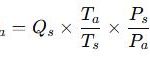
Qs is the standard volumetric flow rate (e.g., sccm),
Qa is the actual volumetric flow rate;
TTT is the absolute temperature (K),
PPP is the pressure (Pa).
This relationship originates from the ideal gas law, which is applied to volumetric flow. Essentially, it converts the “volume defined under standard conditions” into the actual flow rate under working conditions.
What is the difference between CCM and SCCM units?
sccm stands for “standard cubic meters per hour,” which requires prior definition of STP; ccm denotes operating volume flow rate, directly influenced by on-site temperature and pressure. Values of sccm under different STP conditions cannot be directly compared with ccm.
When should SCCM be used?
SCCM (Standard Cubic Centimeters per Minute) is a unit commonly used for measuring gas flow rates under standard conditions. Below are key scenarios where SCCM should be used:
1. Gas Flow Control in Semiconductor and Vacuum Systems
- Use case: SCCM is widely used in industries like semiconductor manufacturing for processes such as chemical vapor deposition (CVD), atomic layer deposition (ALD), and etching. It ensures precise delivery of gases at low flow rates (e.g., nitrogen, argon, oxygen) under Standard Temperature and Pressure (STP) conditions.
2. Calibration and Setting of Mass Flow Controllers (MFCs)
- Use case: SCCM is essential for calibrating mass flow controllers (MFCs) in gas distribution systems, ensuring accurate flow measurement and flow control. It is critical for gas mixing and dilution processes where precise flow rates are needed.
3. Analytical Instruments
- Use case: Instruments like Gas Chromatographs (GC) or Mass Spectrometers (MS) often use SCCM to regulate carrier gas flow (such as helium, hydrogen, or nitrogen). This ensures that the flow rate remains consistent and standardized for accurate readings in chemical analysis.
4. Vacuum Systems and Leak Detection
- Use case: SCCM is used to measure small leak rates in vacuum systems. It helps detect small amounts of gas passing through, ensuring system integrity and optimal performance.
5. Low-Flow Gas Measurement
- Use case: SCCM is commonly used in low-flow applications, where the gas flow is below 1 L/min. This ensures accurate control of small amounts of gas for precise measurement, particularly in research and industrial applications.
6. Laboratory and Industrial Research
- Use case: In laboratory settings, SCCM is used to control gas flow during experiments and tests, ensuring reproducibility and consistency in experiments that require precise gas measurement.
Why Flow Transducers Matter in SCCM Measurement
When working with SCCM, the objective is not just to observe gas flow, but to maintain a stable and repeatable flow value under defined standard conditions. A reliable flow transducer helps by:
- providing fast response for low-flow gas regulation
- improving signal stability in precision dosing or mixing applications
- enabling data logging and remote monitoring
- supporting automatic control together with MFCs, valves, and control systems
For users selecting instruments for low-flow gas service, it is helpful to evaluate not only the SCCM range, but also the sensor principle, output signal, repeatability, gas compatibility, and integration requirements.
Quick Product Selection Guide
| Application | Medium | Flow Range/Unit | Recommended Technology | Recommended Product | Key Reasons |
|---|---|---|---|---|---|
| Precision Gas Low Flow | N₂/Ar/Mixed Gases | SCCM/SLM | MFM/MFC | (Contact Technical Support for Solutions) | Direct SCCM setup, fast response; need to check GCF for cross-gas use |
| Steam/Compressed Gas | Steam/Air | m³/h (with compensation) | Vortex Flow Meter | Vortex Flow Meter | Sturdy structure, low maintenance, suitable for temperature and pressure compensation |
| Conductive Liquids | Water/Wastewater/Chemicals | m³/h | Electromagnetic | Magnetic Flow Meter | No pressure loss, insensitive to viscosity and density |
| Non-Disruptive Retrofit | Cold/Hot Water, Circulating Water | m³/h | Clamp-on Ultrasonic | Clamp-on Ultrasonic | No pipeline interruption, flexible across pipe sizes |
| Clean Low-Viscosity Liquids | Ethanol/Diesel, etc. | L/min | Turbine Flow Meter | Turbine Flow Meter | Wide flow range, high accuracy |
| On-Site Visible/Cost-Sensitive | Gas/Liquid | Reference Conditions | Rotameter (Variable Area) | Rotameter/VA | Intuitive, no power required, note calibration conditions |
Table of Quick Product Selection Guide


Summary
SCCM (Standard Cubic Centimeters per Minute) is an essential unit for precise gas flow measurement, particularly in industries where accuracy and standardization are crucial. It plays a vital role in sectors like semiconductor manufacturing, vacuum systems, laboratory research, and analytical instruments, where maintaining consistent and reproducible flow rates under controlled conditions is key.
Apure is a flow measurement and control brand under Shanghai GL Environmental, offering solutions based on multiple measurement principles—from electromagnetic and ultrasonic to vortex, turbine, and rotor—to meet volume, mass, and concentration measurement needs for liquids, gases, and steam. Contact our professional team for customized water treatment solutions.